Broadening Horizons, Opening Hearts

The NDSU Transition and Access Program makes history, graduating its first class of students with developmental disabilities and bringing a new sense of belonging to the Bison Herd.

Story by Sarah Coomber | Photos by Britta the Photographer

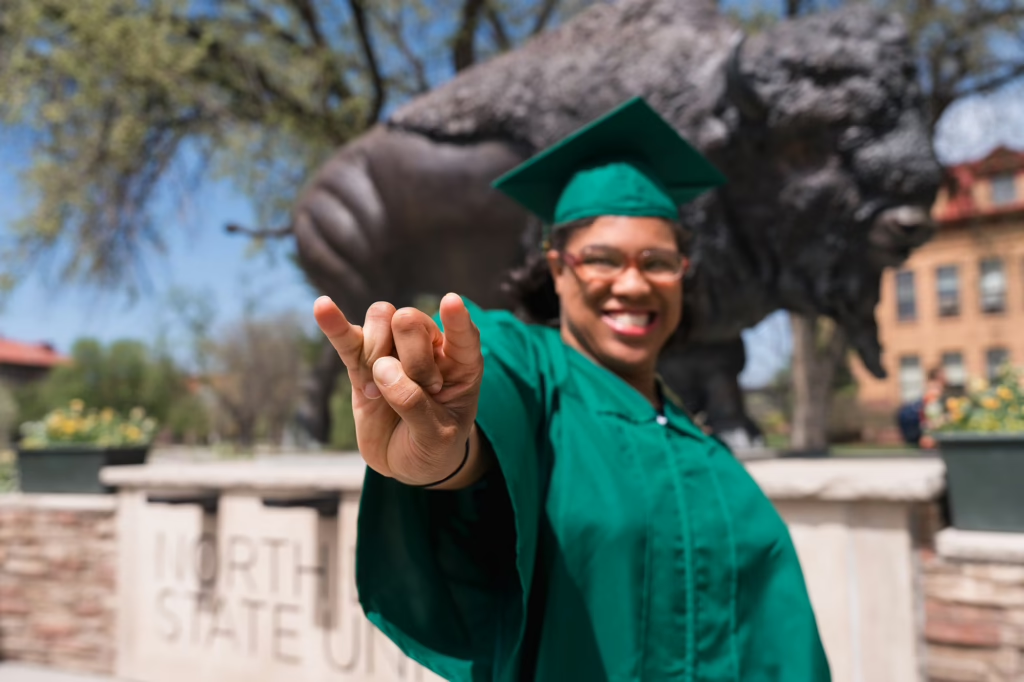
NDSU Transition and Access Program graduate Alexander Aikens posing in front of the Bison Statue at NDSU.

Alexander Aikens ’26 might seem like an unlikely pioneer.  

She arrived on campus in 2021 after spending her school years in special education classrooms. Her speech had a different rhythm from the typical undergraduate, and her walk had a different cadence. A lifelong music lover, she planned simply to sing in choir. 

But this past May, Alexander became one of the first three students to graduate from the NDSU Transition and Access Program (TAP). She earned a three-year College-to-Career Certificate with a concentration in music. 

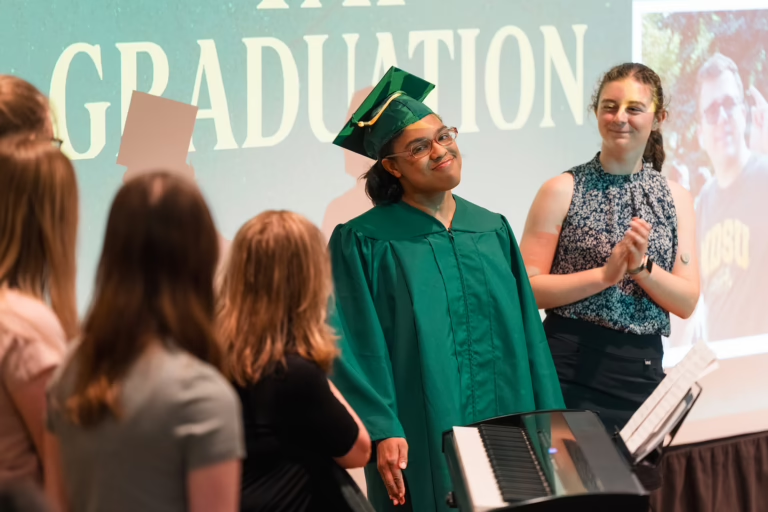
At graduation, Alexander took the mic. “We did it!” she called out, flashing her jubilant smile at the crowd that had gathered to celebrate with her and her classmates. 

Alex and Her Big Dream

Alexander was a middle school student when she told her parents she planned to graduate from NDSU, where her dad, Dr. Shontarius Aikens, worked in the College of Business. 

But when she shared her dream with her classmates and teachers, “they’d kind of laugh her off,” recalled her mom, Christyal Alexington, a special education teacher at Carl Ben Eielson Middle School in Fargo. 

They knew Alexander as a girl who needed someone to walk her from class to class so she wouldn’t wander off, as a special education student who was assisted by paraprofessionals in general education classes. 

Alexander, however, has never been easily deterred. She’s been overcoming odds since the day she was born, 14 weeks ahead of schedule. 

Weighing in at only 1 pound 11 ounces, she could wear her dad’s wedding ring around her wrist, with room to spare. Her life began with heart surgery and an extended hospital stay. She has since had multiple surgeries on her hips and legs, relearning how to walk, again and again and again. 

Shontarius, now an associate professor at Concordia College, says Alexander brings a resilient approach to life. 

“If there is something she wants to do, she goes after it and doesn’t give up,” he said. 

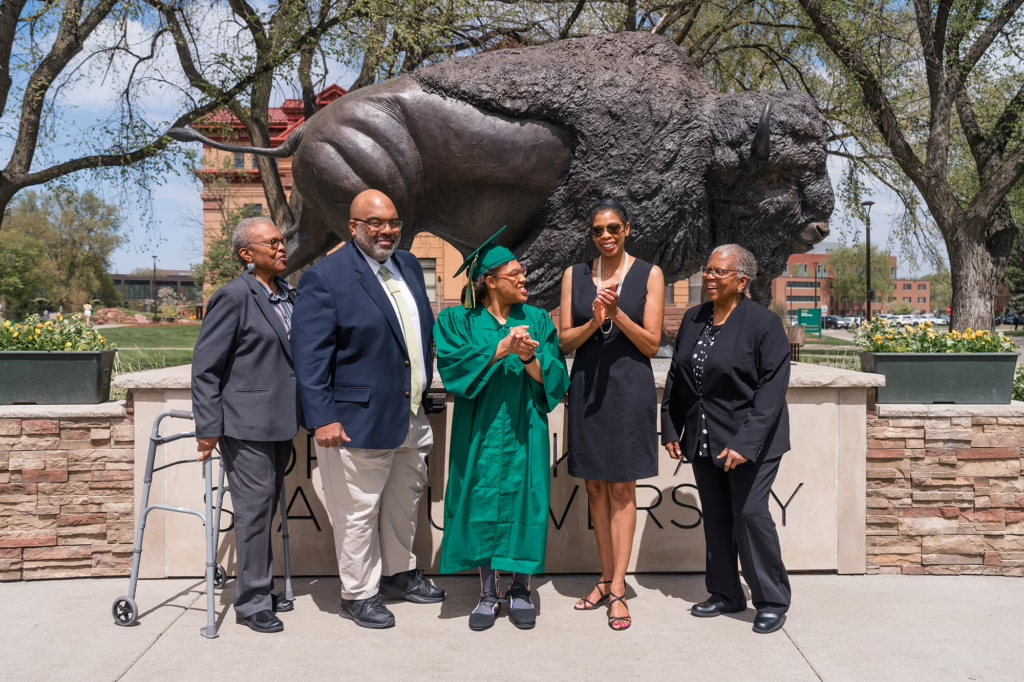
NDSU Transition and Access Program graduate Alexander Aikens standing in front of the bison statue with her family, including Dr. Shontarius Aikens and Christyal Alexington.

Attending NDSU introduced Alexander Aikens ‘26 to a whole new world. Her family, including parents Dr. Shontarius Aikens (center left) and Christyal Alexington (center right) celebrated her graduation. “She carries herself as an adult now,” Christyal said. 

This seems to be a family trait. 

When Christyal learned of her daughter’s dream to be a Bison, she hatched a plan: Alexander, who had been singing since she was 2 years old and had participated independently in various choirs, would take four years of choir at NDSU and then “graduate out.” 

A New, Land-Grant Approach

Meanwhile, the NDSU Center for Accessibility and Disability Resources was collaborating with faculty and staff campus-wide to create a new program: TAP. It would offer a flexible curriculum and provide support to students with intellectual and developmental disabilities. 

Currently more than 300 U.S. colleges and universities offer similar programs for students who traditionally have not had the opportunity to get a higher education. 

The goal of TAP involves more than inviting a new group of students into classrooms. It weaves together a web of departments and offices across NDSU that support TAP students as they fully integrate into academic, social, and living experiences and prepare for careers after graduation. 

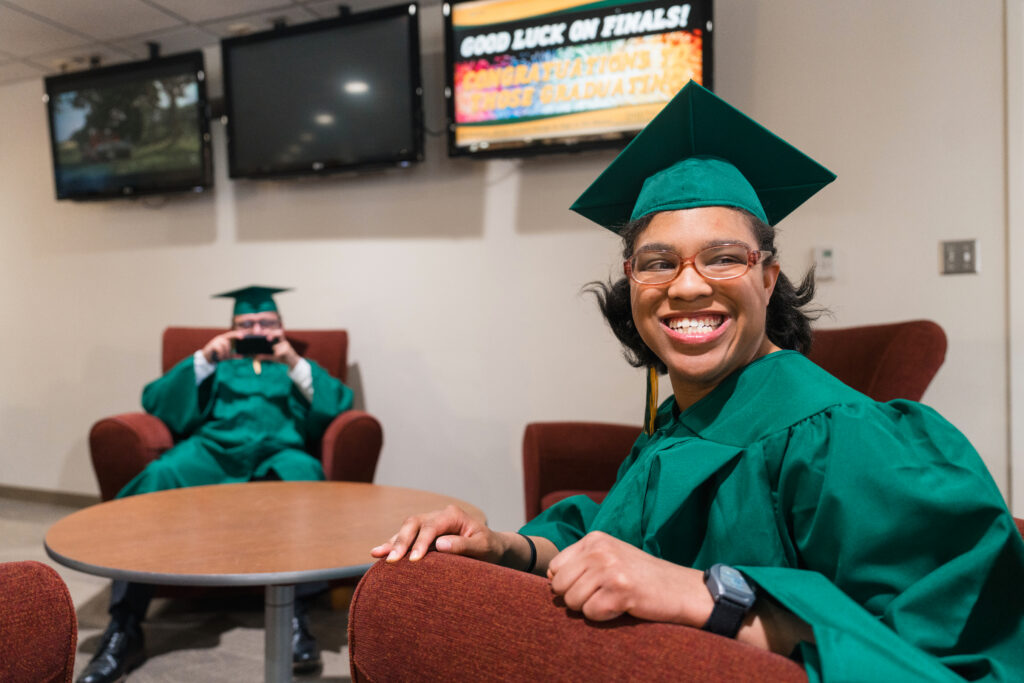
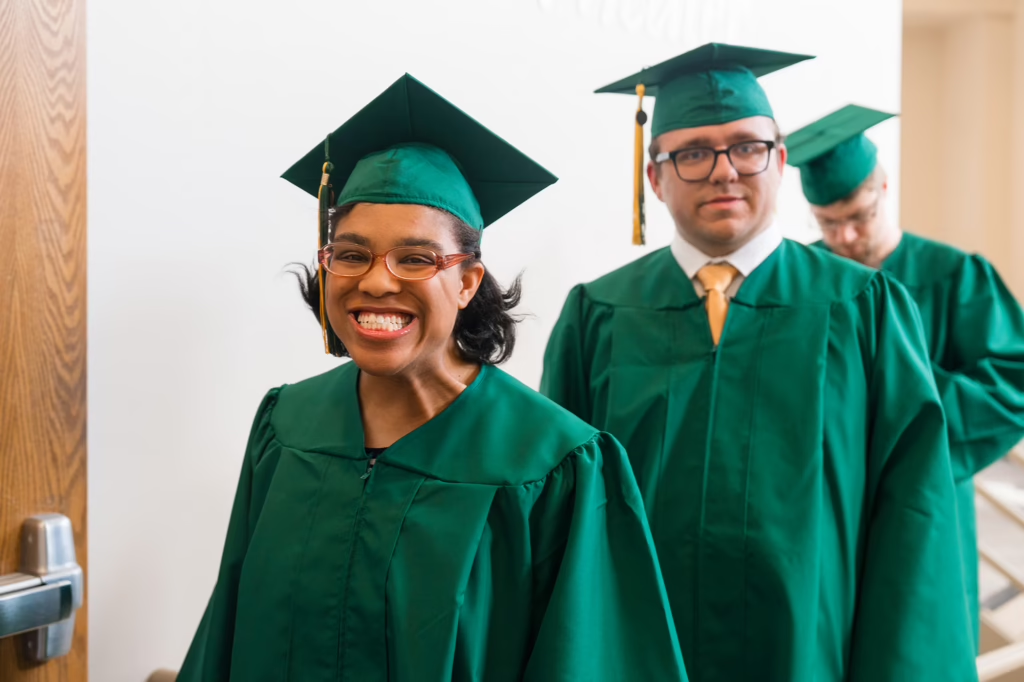
NDSU Transition and Access Program graduates smiling while getting ready to walk at graduation.

While at NDSU, Alexander experienced internships, work, and volunteer opportunities. She also co-presented at conferences and sang the national anthem at Bison sporting events. 

“We talk a lot about NDSU being a land-grant university, and that the mission is to provide education, experiences, and opportunities for all people,” TAP director Dr. Molly McKinnon said. “I can’t even say enough good things about all of the departments that have created unique pathways for us.” 

Alexander’s NDSU Journey

A couple of years before TAP existed, when Alexander arrived on campus to sing in choir, Christyal noticed people staring at her daughter. 

“They were not mean looks,” she said, “but I could see they did not picture her as a student.” 

However, as a member of the Cantemus soprano/alto chorus, Alexander started getting to  know other students. 

“The longer she was at NDSU and the more involved she got, the more friends she made,” Christyal said. “People were seeing her as a person and not her disability.” 

Alexander said she loved singing with the choir, particularly their performances of Handel’s Messiah: “It was really good. I know the words, I know everything.” 

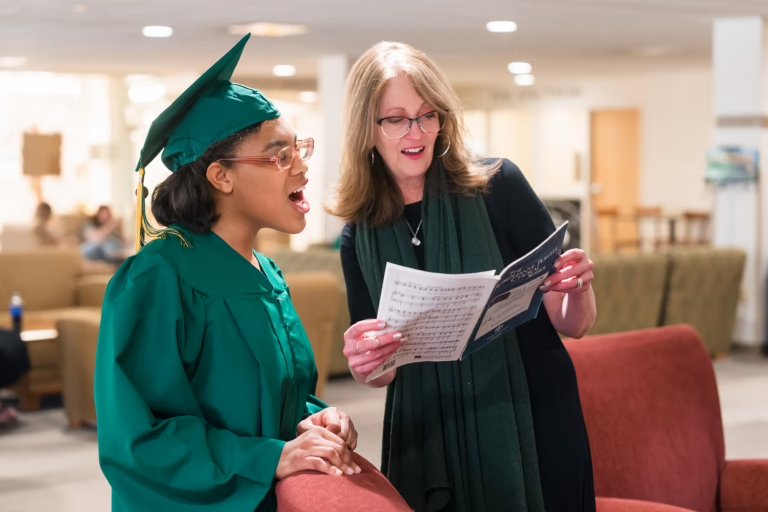
Her choir director, associate professor Dr. Charlette Moe, says Alexander arrived as a strong musician, and her vocal tone grew warmer during the five years she was in Cantemus. The only thing Charlette adapted for Alexander was a performance protocol: She and the choir members made sure Alexander arrived safely to her spot when processing in and going up and down stairs. 

“Learning from others benefits the person, but it also benefits the rest of us,” Charlette, who retired from NDSU last spring, said. “Alexander changes lives. She changed mine.”

In 2023, when Alexander entered the brand-new TAP, she continued with choir and expanded her studies to include classes in music, communication, computer applications, financial management, and public speaking. 

Like other NDSU students, she found internships and on-campus jobs, volunteered, and joined clubs. She used her computer skills at the library to transfer thesis files from one database to another. She washed pots in the greenhouse, sang with kids at the NDSU Center for Child Development, and practiced with the cheer team. 

Perhaps the best experience of all was supporting her beloved Bison by singing the national anthem at various sporting events.  

“I believe each time she performed at NDSU, whether for choir or singing the national anthem, she was changing how people see the norm,” Christyal said.

A Campus-Wide Collaboration

In addition to taking core NDSU and TAP courses, each student takes classes in one of six career pathways: 

TAP staff assist faculty with making instruction accessible to these learners, and trained peer mentors support the students in class, helping them with notetaking and other tasks.  

These students often bring something special to their courses, expanding the usual conversations, says Molly, TAP’s director. “Sometimes brains take a different route to make the same connection,” she said. “Along with that, integrated learning creates patience, empathy, understanding — those soft skills that I think sometimes we miss when we just want to take a straight path.” 

But academics is only one of the program’s four pillars. The others are social, employment, and independent living. Peer mentors — traditional university students — are integral to helping TAP students participate fully in university life.

The Transition and Access Program graduates are all smiles after graduation.

The TAP graduation ceremony celebrated three students (above) who dared to take a new path with support from the NDSU community.

One of the program’s original mentors, Jayli Wandler ’26, was introduced at graduation as “the big sister of the program.” 

“She is always willing to have dinner, go shopping, or give advice,” TAP coordinator Jordan Bentz ’21, ’24 said. “She served this program not only as a mentor but as a friend. A best friend. An advocate.” 

With plans to go to dental school in the future, Jayli says she wants to continue helping people with disabilities. 

“My life revolved around TAP,” she said. “I arrived at school without a purpose, and I found one.” 

The Possibilities of TAP

Now in its fourth year, TAP continues to grow, with 25 students enrolled in the 2026 to 2027 academic year. So far, its students have come from North Dakota, Minnesota, South Dakota, and Ohio. (The student from Ohio chose NDSU in part because he is a fan of Bison football.) 

For her part, Alexander, now 26, is long past needing someone to walk her from class to class. She is even starting to use paratransit transportation to get around her community. 

“It’s just so much freedom,” Molly said, “and she’s really proud of that.” 

Christyal says she’s telling the middle school students in her special education classes about TAP and Alexander’s experiences at NDSU. “I want them to have a goal in life to reach towards. I keep telling them that they can go to college,” she said. “A person is a person. Everyone can follow their dreams.” 

Share This Story

Related Stories

Margaret and her husband, Hugh Veit ’79, established the Eleanor S. Fitzgerald Memorial Graduate Student Scholarship to support NDSU students earning advanced degrees in the Department of Health, Nutrition, and Exercise Sciences or the Department of Human Development and Family Science.

Core areas of home economics remain part of current NDSU degree programs such as accounting; apparel, retail merchandising, and design; education; family and consumer science; financial planning; human development and family science; interior design; and nutrition science.

Home economics programs opened doors, particularly for women, to earn college degrees and pursue careers in education, Extension, state and federal government, business and industry, health care, and more. NDAC listed domestic economy as one of its courses in its founding year, 1890.

Established by Dr. Teresa Conner, dean of the NDSU College of Health and Human Sciences, and co-chaired by Dr. Margaret Fitzgerald ’83 and Col. Esther Meyers ’75, the Wisdom Keepers provide support and share their knowledge and expertise with students, faculty, staff, and leadership in the College.

The home management house at NDAC was the first facility built on a college campus specifically for home management practice. In 1954, it was named in honor of Alba Bales, the first female academic dean at NDAC.