
At NDSU, Alyssa Hodges ’21, ’23, ’26 discovered a community ready to support her in ways she hadn’t expected.
Read More

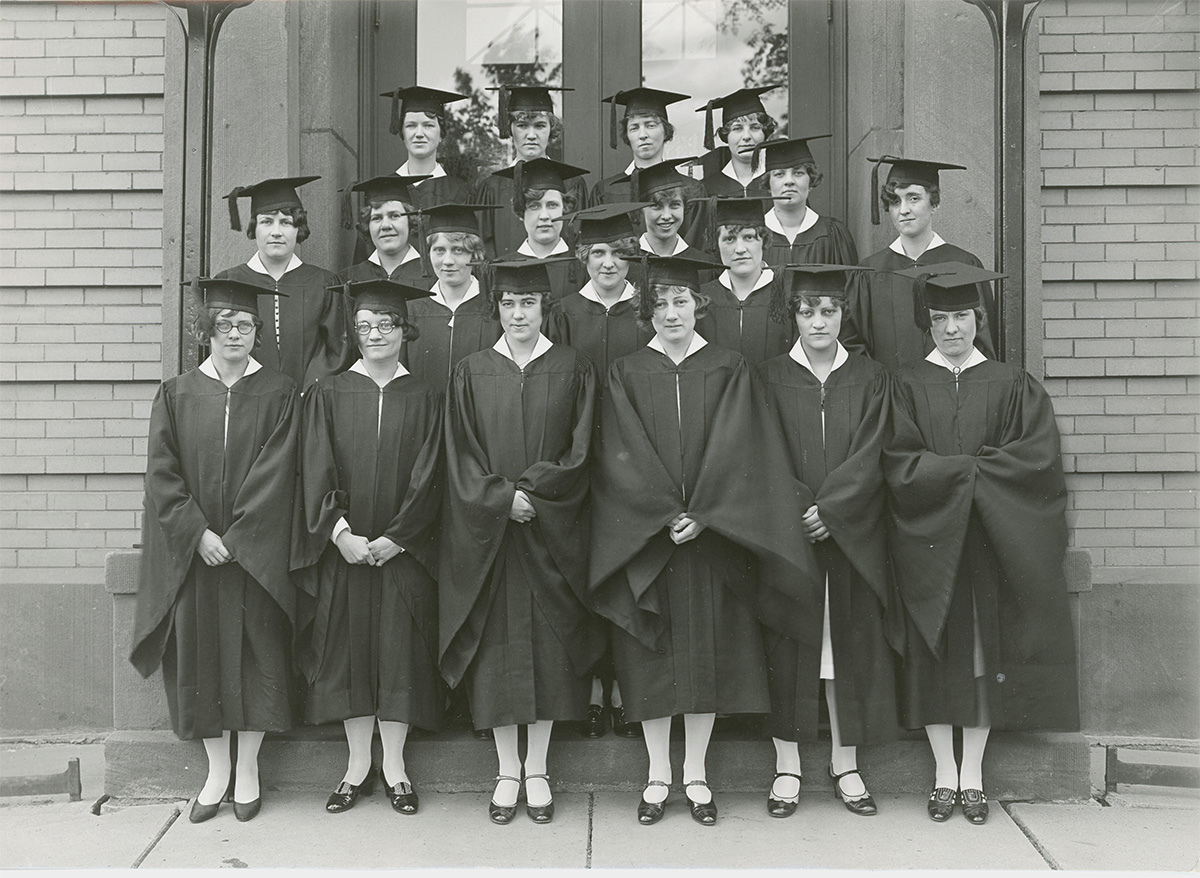
“Today’s achievements are but the harvest of good seeds, well sown, and of plants well-tended throughout past years.”
– Leita Davy, Forty Years of Home Economics at NDAC
As she studied a photograph of her mother, Eleanor (Stoltenow) Fitzgerald ’38, in an old Bison yearbook, Dr. Margaret Fitzgerald ’83 lit up.
“Oh, look at her,” Margaret said, doting on how young her mother appeared in her final year of college.
“I’ve never seen a photo of her that young,” Margaret’s son, Matthew Veit ’23, said. He was only 4 years old when his grandmother, Eleanor, passed away.
He and Margaret examined the yearbook together, noticing the inscription beneath Eleanor’s name, which lists her involvement in campus organizations like Ceres Hall Club, Glee Club, riflery, and — much to her family’s surprise — basketball.
“Baller?” Matthew asked, leaning in to take a closer look. He currently serves as the head coach of the girls basketball and softball teams at Fargo Davies High School and did not know his grandmother once shot hoops too.
Three generations of the Fitzgerald/ Veit family — Eleanor, Margaret, and Matthew — earned degrees from NDSU, or North Dakota Agricultural College (NDAC) as it was known when Eleanor was enrolled as a student in the home economics program.
On this occasion, Margaret and Matthew were gathered around a table to share stories about Eleanor and reflect on the legacy of trailblazing home economists who were educated in the land-grant tradition and made important contributions in teaching, research, and Extension services.
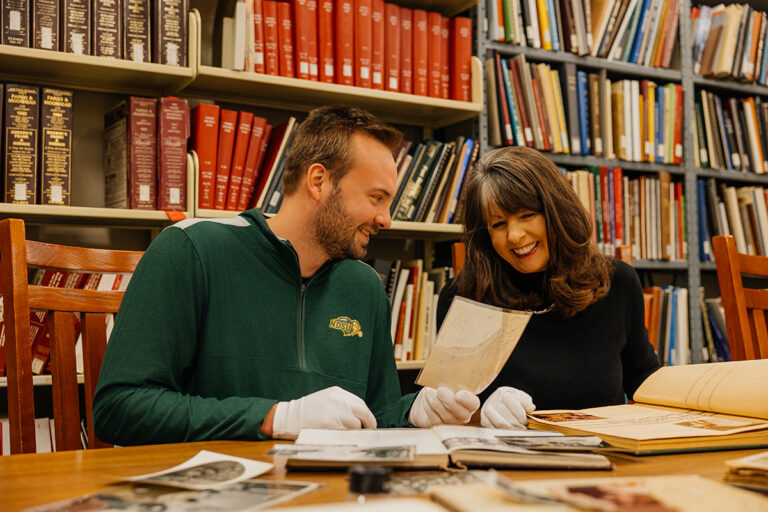

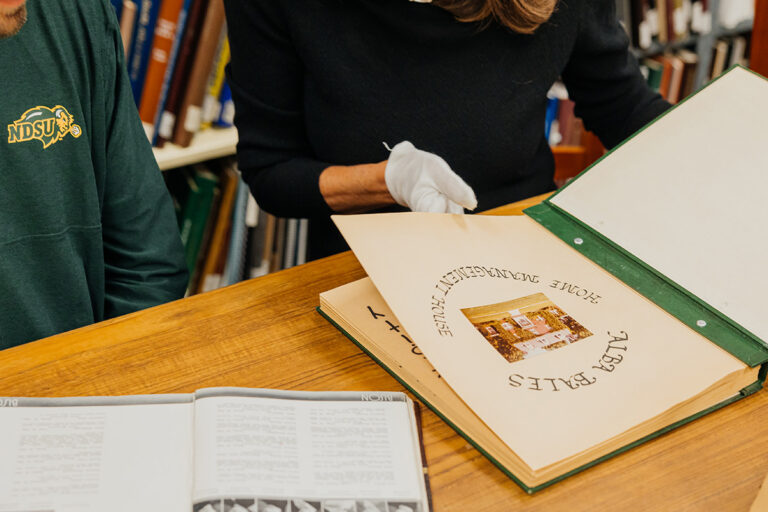
Matthew Veit ‘23 (left) and his mom, Dr. Margaret Fitzgerald ‘83 (right), search through boxes of home economics memorabilia at the NDSU Archives in Fargo.
Margaret and Matthew each brought a unique perspective. Matthew recently graduated with his master’s degree from NDSU in leadership in physical education and sport, where he cultivated a passion for coaching and youth development that he shares with his students and student-athletes.
“I didn’t know my grandma very well, but the roots have stemmed because she had a passion for home economics, and my mom found her passion in something similar, and those things they studied … that tradition and knowledge … has been passed on to me and set me up for success,” Matthew said.
Margaret is an emeritus provost, professor, and dean of what is now called the NDSU College of Health and Human Sciences. She currently serves as co-chair for the NDSU College of Health and Human Sciences Wisdom Keepers .
“When I think back to my mom and her friends, a lot of them were home economists. They might have worked in Extension, or as high school teachers, or as interior designers, but they were all trailblazers,” Margaret said. “They were leaders in their communities, schools, churches, and organizations. These were women who knew how to get things done.”
Eleanor graduated from NDAC more than 40 years before her daughter, Margaret, and more than 80 years before her grandson, Matthew.
“Mom earned a degree at a time when very few women, or even men, went to college,” Margaret explained. “The domestic sciences enabled women, especially those from rural backgrounds, to access higher education.”
She pointed out that when Eleanor first arrived as a student at NDAC in the mid-1930s, she left behind a family farm in Great Bend, North Dakota. While Eleanor’s family had electricity and running water, most rural homes in the Great Plains region did not have those utilities until the Rural Electrification Act of 1936 or later.
When Eleanor and her peers in the home economics program first stepped foot on the NDAC campus, many students must have been delighted by the modern amenities more common in urban areas like Fargo — especially those in the home management house .
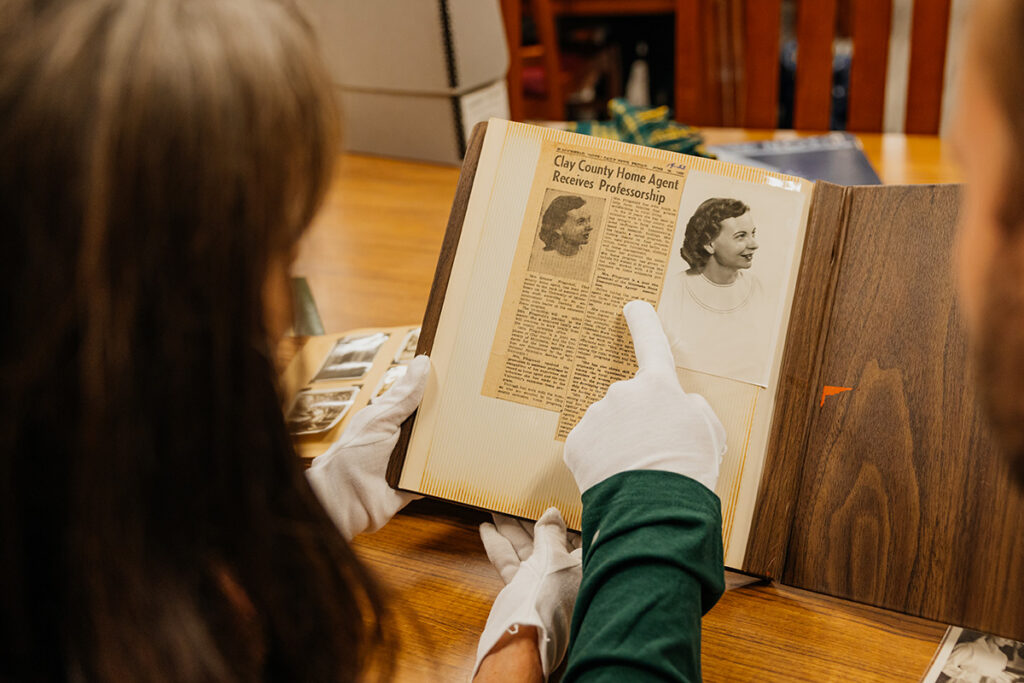
A newspaper clipping depicts Eleanor (Stoltenow) Fitzgerald ’38, who earned her degree in home economics education and worked in Extension.
“The home management house was a model laboratory for young women, and so it was often their first exposure to the latest appliances, principles of budgeting and money management, and the fine art of entertaining,” Margaret explained.
More than 1,200 women lived at the home management house in its 58 years of operation. The six-week residency served as a graduation requirement and an opportunity for home economics students to put their skills into practice in a real home setting. Duties included maintaining a budget; planning, preparing, and serving meals; cleaning; laundry; caring for walks and porches; managing the furnace; and entertaining guests.
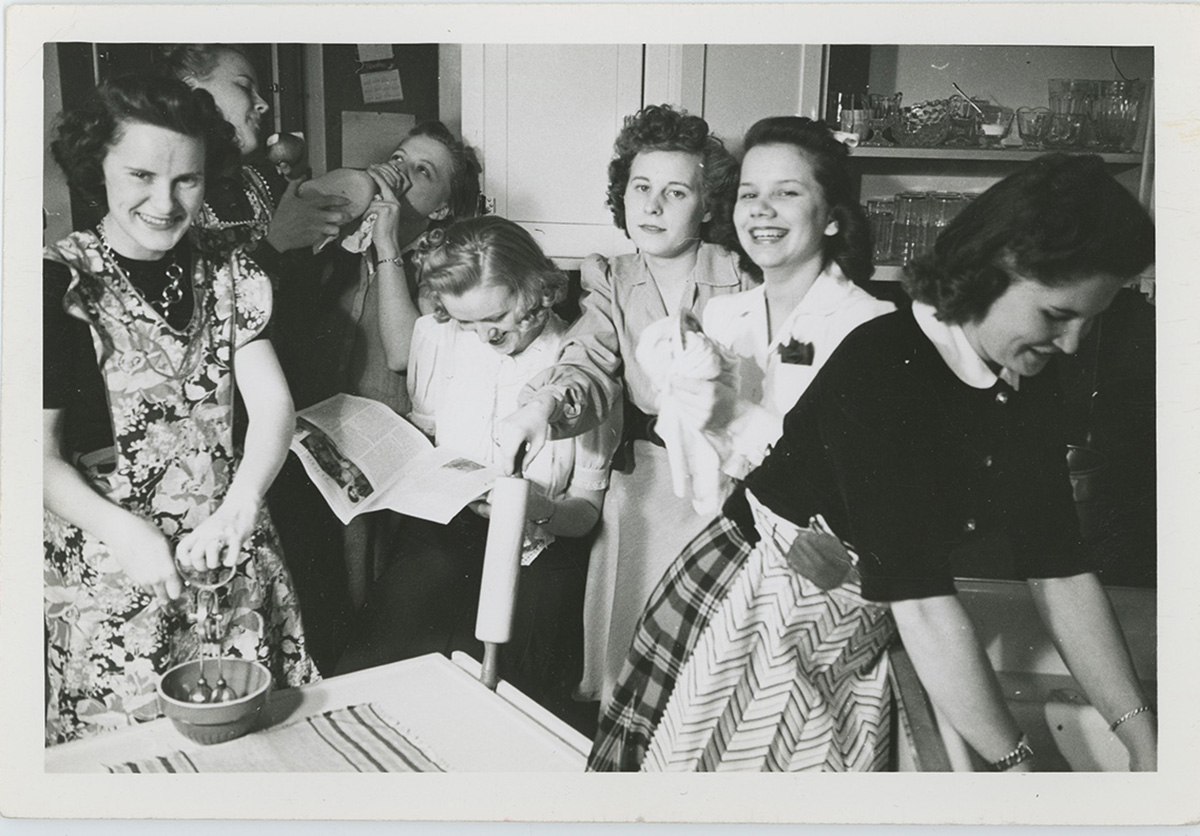
A group of student residents in the kitchen of the home management house, February 1942.
During Eleanor’s residency in the home management house, she was responsible for hosting a high-end dinner party. As Margaret recalls, Eleanor received the largest budget of all her peers.
“I could have sworn she said she made lobster, but then I got to thinking, ‘Where did she get lobster in North Dakota in the 1930s?’” Margaret mused. “For a girl who grew up on a farm in North Dakota, to come in and prepare an elegant meal and entertain others and be the gracious hostess … it was very intimidating.”
Eleanor graduated from NDAC with a degree in home economics education, taught home economics in two high schools, and later worked for the University of Minnesota Extension Office in Clay County, where she was promoted to the rank of assistant professor. Later, she did special projects for NDSU Extension, including a demonstration TV segment called “Ask Eleanor.”
“I think she felt a lot of responsibility because she had the privilege and opportunity to go to college,” Margaret said, “so she was always teaching and helping people and sharing what she had learned.”
Like her grandson, Matthew, Eleanor was dedicated to youth development. She mentored and prepared 4-H leaders to work with young people, and she also worked directly with 4-H participants on their projects for county and state fairs.
“Matthew wants to motivate students toward success,” Margaret said. “He’s leading from where he’s at, in terms of his own school and the sports community, and he cares deeply for the kids that he teaches and coaches … I very much see my mom in him.”
The home management house hosted its last live-in residents in 1981, while Margaret was an undergraduate student at NDSU. As she earned her degree in child development and family relations and pursued a career in teaching, she experienced the evolution of the domestic sciences firsthand.
In 1988, Margaret returned to NDSU as a faculty member in the College of Home Economics. She taught courses in financial planning, public policy, and gerontology in the same academic unit that had imparted lessons on food and nutrition, clothing and textiles, and educational principles when Eleanor was a student.
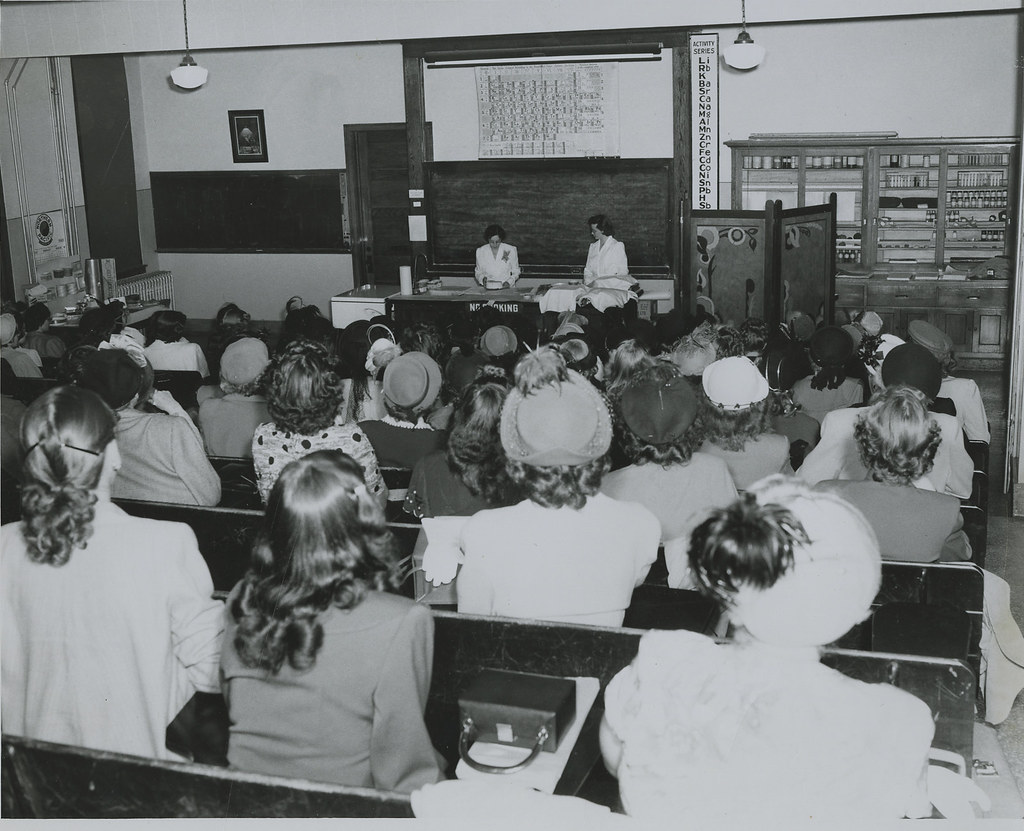
NDAC students observe a classroom demonstration on cakes, 1950s.
This led to some friendly teasing between mother and daughter. For all the skills and intelligence Margaret possessed, Eleanor would jokingly remind her she could “barely cook” and “hardly ever sewed.”
Yes, the times were changing, but the core principles of the domestic sciences — scientific methods and practical application — remained the same. In fact, the home economics program established at NDAC in 1890 helped lay the foundation for the hands-on education and innovative teaching and research taking place across NDSU’s academic colleges today.
“The programs that were core areas of home economics still exist at NDSU and other institutions and are no longer limited to women,” Margaret said. “Although names and structures have changed over time, home economics’ emphasis on multidisciplinary programs that focus on applied science to improve people’s lives is still of critical importance.”
The legacy of home economics at NDSU is sustained by the University’s commitment to practical, hands-on education and the development of new knowledge — but it also lives on through individuals like Margaret, Matthew, and Yufang Tu ’27, who holds the Eleanor S. Fitzgerald Memorial Graduate Student Scholarship .
Motivated by the desire to help people lead healthier and more fulfilling lives, Yufang is pursuing a dual Ph.D. in developmental science and gerontology at NDSU.
“Receiving this scholarship helped ease my financial burden as an international student from Taiwan, but most importantly it allows me to focus more fully on my research, teaching, and community engagement,” Yufang said.
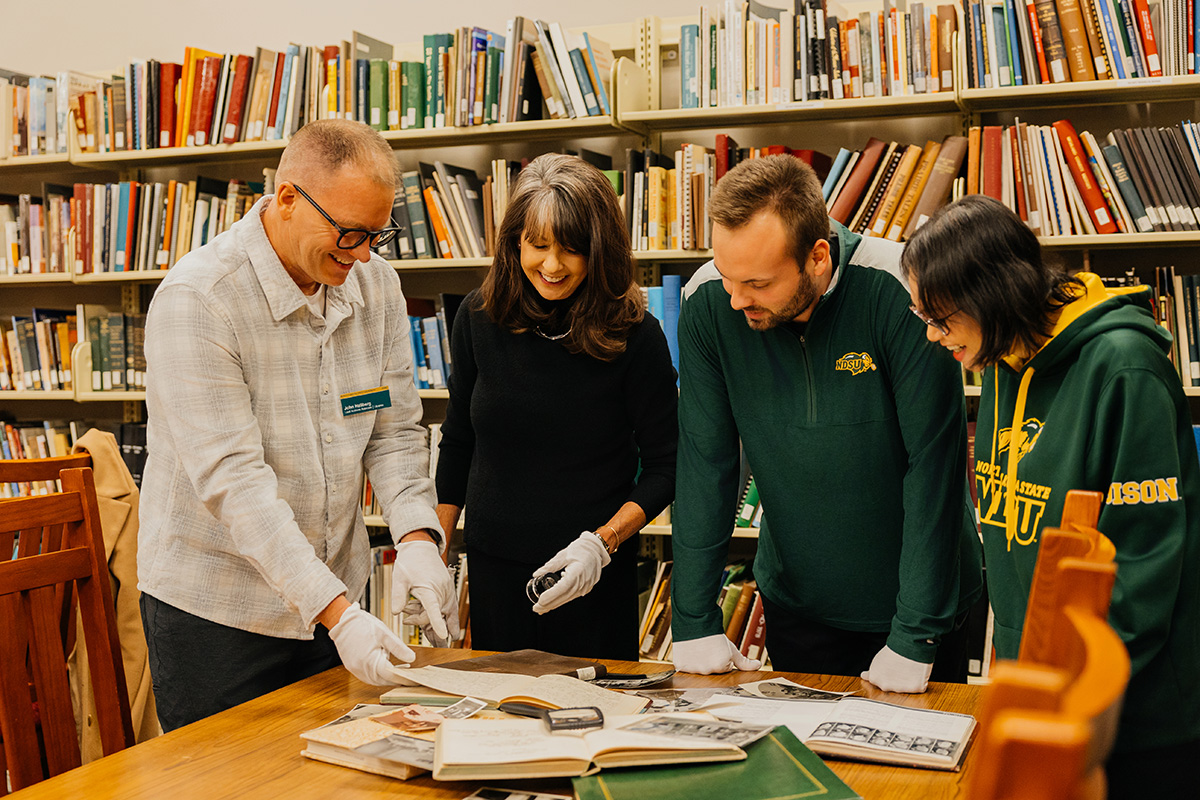
From left to right: Lead archives associate John Hallberg, Margaret, Matthew, and Ph.D. candidate Yufang Tu ’27
In addition to her coursework, Yufang creates caregiving resources for NDSU Extension, volunteers at Sanford Health, and serves as a community educator for the Alzheimer’s Association. Drawing on her internship experience in Dr. Ellen Langer’s Mindfulness Lab at Harvard University, Yufang also leads mindfulness workshops at Good Samaritan Society, a senior living community in Fargo.
“Trailblazing women like Eleanor opened the doors for students like me to pursue advanced education and meaningful careers,” Yufang said, “and I try to honor that legacy by using my opportunities to serve others.”
It’s a value that Eleanor embodied, and one that carries on through Margaret, Matthew, and Yufang still today. As they each pursue education, careers, and outreach, they are reminded of Eleanor and the home economists who imparted positive values and greater educational opportunities for their families, communities, and NDSU.
“From the stories that I’ve heard growing up, or even new stories that I heard my mom share today, my grandma’s legacy is about caring for others,” Matthew said. “I think that’s a very noble thing.”
At NDSU, Alyssa Hodges ’21, ’23, ’26 discovered a community ready to support her in ways she hadn’t expected.
Read MoreNDSU students bring companionship and events to residents in memory care at Fargo’s Touchmark retirement community.
Read More Margaret and her husband, Hugh Veit ’79, established the Eleanor S. Fitzgerald Memorial Graduate Student Scholarship to support NDSU students earning advanced degrees in the Department of Health, Nutrition, and Exercise Sciences or the Department of Human Development and Family Science.

Core areas of home economics remain part of current NDSU degree programs such as accounting; apparel, retail merchandising, and design; education; family and consumer science; financial planning; human development and family science; interior design; and nutrition science.

Home economics programs opened doors, particularly for women, to earn college degrees and pursue careers in education, Extension, state and federal government, business and industry, health care, and more. NDAC listed domestic economy as one of its courses in its founding year, 1890.

Established by Dr. Teresa Conner, dean of the NDSU College of Health and Human Sciences, and co-chaired by Dr. Margaret Fitzgerald ’83 and Col. Esther Meyers ’75, the Wisdom Keepers provide support and share their knowledge and expertise with students, faculty, staff, and leadership in the College.
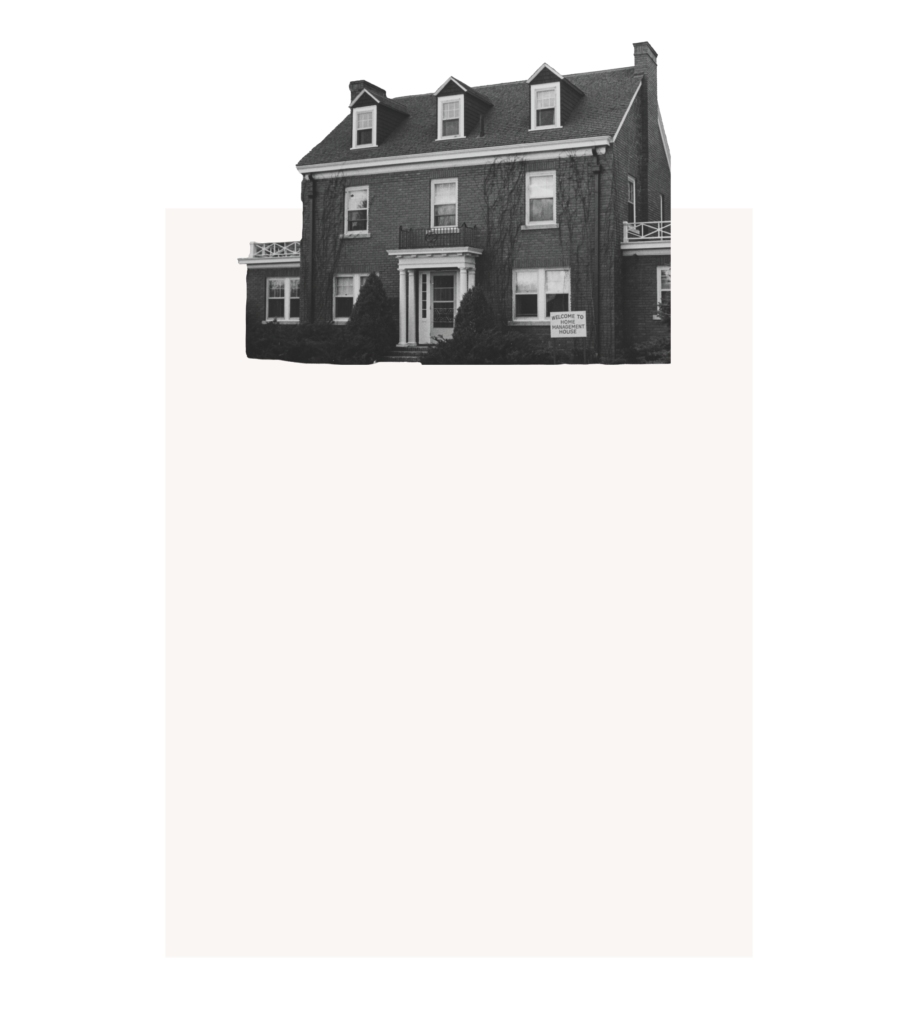
The home management house at NDAC was the first facility built on a college campus specifically for home management practice. In 1954, it was named in honor of Alba Bales, the first female academic dean at NDAC.