

NDSU researchers in the coatings and polymeric materials department are upholding a 120-year tradition of industry-leading breakthroughs.
Read More

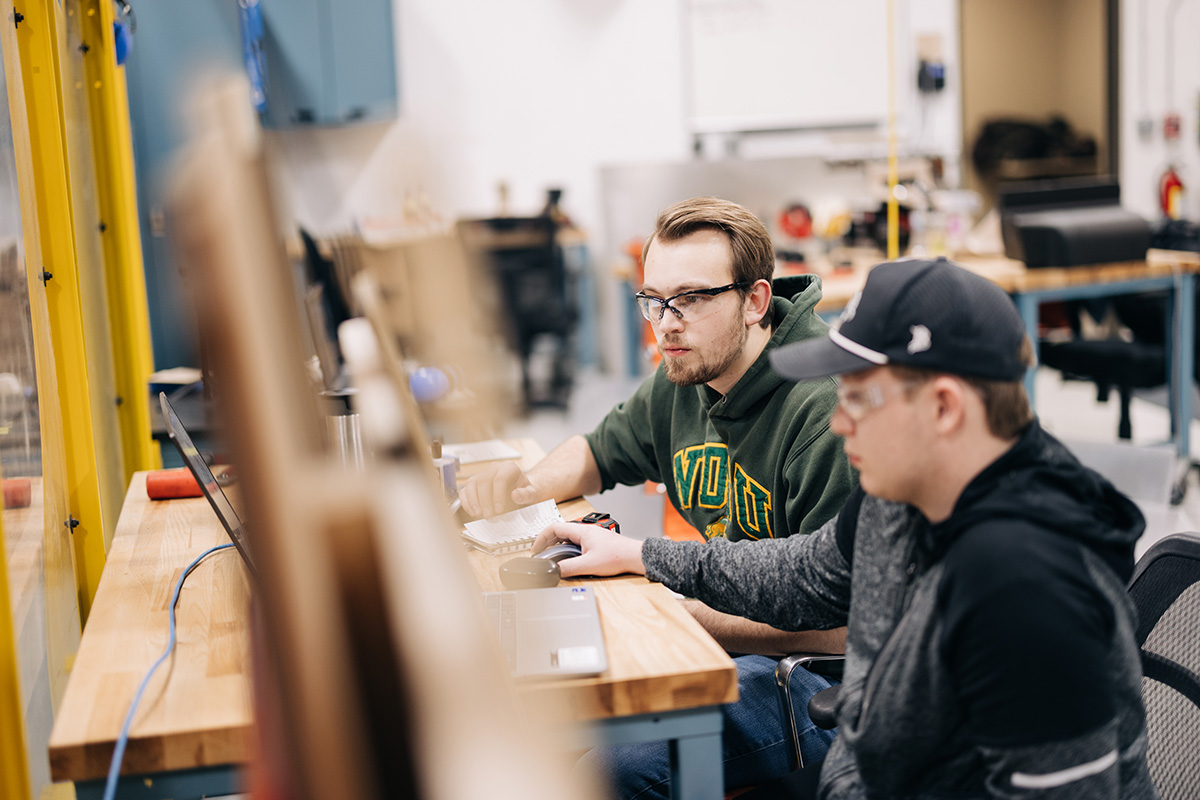
As most NDSU students enjoyed their final days of holiday break, members of the Bison Robotics club were already back on campus, preparing to strategize, design, build, wire, program, and test a fully functional robot in just three days.
Inspired by FIRST, a global youth robotics community that hosts an annual high school robotics competition every January, this challenge is called Robot in 3 Days (Ri3D), and many universities participate. Fueled by adrenaline and caffeine, NDSU’s Ri3D team tuned in for the FIRST Robotics Competition (FRC) global kickoff stream to watch an overview that would guide their robot’s design and function.
This year’s game challenged students to create robots that could score “fuel” (yellow balls) into a “hub” (basket), while also navigating field obstacles and a climbing tower. Points were awarded across multiple phases of play, including fuel collection, shooting, and climbing.
While the competing high school teams would have six weeks to build their robots after the FRC game reveal, the goal for Bison Robotics was to compress the entire engineering cycle into one long weekend — creating a robot to serve as inspiration for high school teams in the weeks to follow.
“The main goal for me is to give high school competitors with smaller teams and tighter budgets a prototype they can learn from,” computer science major and Harry D. McGovern Scholar Dylan Rattai ’28 said. “I want them to have a better robot at the end of their six-week build cycle, even as they’re still learning strategy, design, or coding fundamentals.”
For the Ri3D team, it isn’t about competition. They aren’t striving for awards or rankings, but rather the opportunity to show what’s possible.
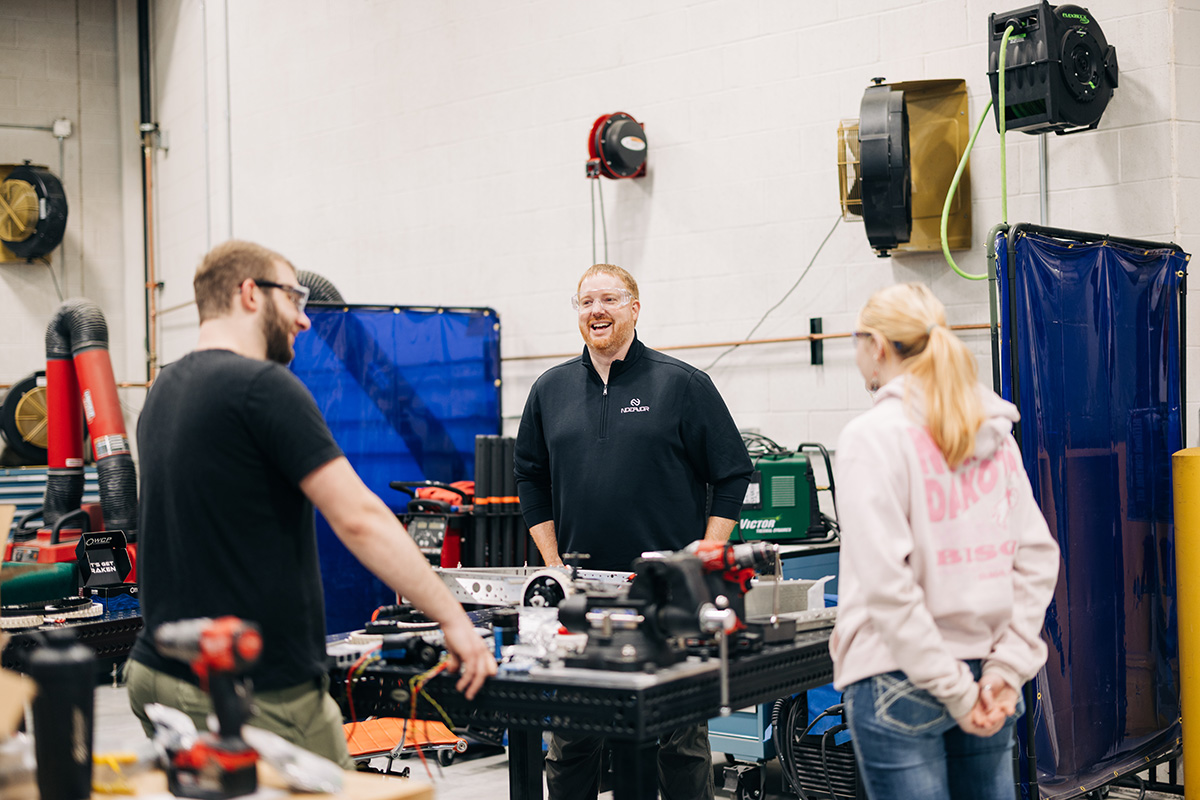
NDeavor mentors offer guidance and practical expertise throughout the robot-building process.
After watching the initial stream, the countdown began, and creativity took hold almost instantly. Students broke into animated chatter, leaning toward their neighbors to share ideas and pulling up searches on their laptops to show design concepts they thought could work.
Sensing the surge of excitement, Ri3D lead and mechanical engineering major Jacob Vaerst ’27 called the room to attention. He organized the team into four small groups, each composed of students representing the varying engineering majors involved.
One of the most striking aspects of the Ri3D challenge is how many disciplines converge in such a short time.
For many students, Ri3D is an exciting opportunity to actively work with peers outside of their specific engineering major, and that collaboration is one of the most important parts of this project.
“A mechanical engineer is going to learn different things than a computer science major, so when it comes to different areas of the robot, different disciplines must step up based on what they know,” Jacob said. “It teaches us to lean on and trust each area of the team to create a robot in such a short amount of time.”
During the first breakout session, each group reviewed the rulebook before reporting back to the full team, allowing students to dive deep into the game’s requirements and ensure no rules were overlooked.
They uncovered the robot’s design guidelines, from movement and size constraints, and laid out the rules for penalties and scoring.
The team then regrouped into four new breakout sessions to brainstorm robot design concepts. When everyone reconvened, each group presented its ideas, focusing on ball intake, storage, shooting, and climbing — their creativity on full display.
Groups derived inspiration from snowblowers and washing machines. They made sketches on the whiteboard that featured belt-driven intake systems feeding the balls into a storage hopper and a shooter capable of firing multiple balls at once. Others discussed climber designs with a multi-hook system to improve stability.
The presentation of ideas prompted energetic discussion, purposeful questions, and respectful yet focused debates — particularly around intake placement, such as cutting into the bumper versus going over it, and how each option would affect the robot’s ability to take on damage.
Drawing on experience from past Ri3D seasons, veteran students weighed in on what designs had or hadn’t worked before. Ultimately, the discussion helped narrow options to a few main design directions that balanced creativity with effectiveness, reliability, the constraints of the rulebook, and limited build time.
While the deadlines added pressure, the atmosphere remained collaborative and supportive as students cycled through design sessions, prototype builds, wiring, coding, and testing.
“People help each other whenever someone gets stuck, and workload shifts as needed so the team can still hit deadlines together,” Dylan said. “It also helps that many people in Ri3D have worked with the technologies we use before, so there’s usually someone around who knows what needs to be done and can help keep things moving.”
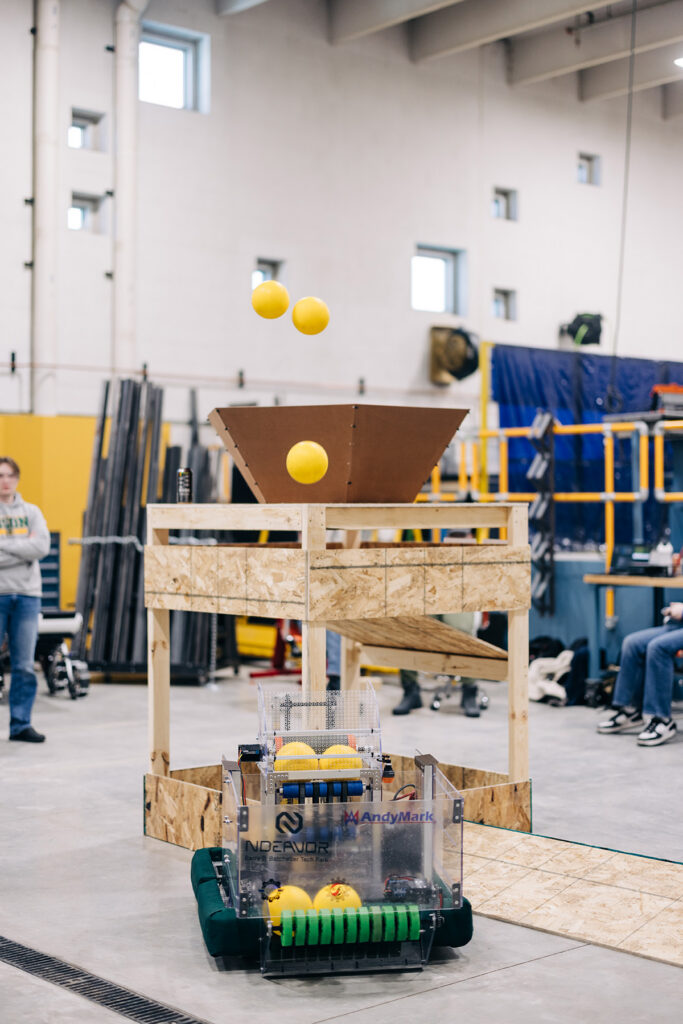
Teams earn points when their robots score fuel into a hub as “Chad” demonstrates above.
The robot, who the students playfully began calling “Chad,” took shape inside the Innovation Studio located within the NDeavor™ Barry D. Batcheller Tech Park. An engineering and prototyping foundry that holds a long-standing partnership with NDSU, NDeavor is built to support hands-on innovation and rapid problem-solving.
NDeavor’s Innovation Studio offers professional-grade tools and resources in metalworking, woodworking, textiles, electronics, and digital fabrication — empowering community members, organizations, and businesses to develop their own unique ideas and projects.
NDeavor views student organizations like Bison Robotics as strategic partners who activate the space with creativity and momentum. In return, the NDeavor team helps the students grow by offering mentorship and space to ideate.
“Testing, refining, and learning from failure are expected and encouraged parts of the process,” Adam Elznic, manager of incubation and innovation at NDeavor, said.
Inspired by the way Ri3D reflects everyday engineering scenarios — tight timelines, shared resources, and open-ended problem solving — as well as by Bison Robotics’ broader work, NDeavor provides the club with free access to the space and a dedicated workroom for projects.
“Students can work in ways that mirror real-world innovation environments,” Adam said. “They have room to spread out, prototype quickly, and collaborate across disciplines.”
While the mechanical engineers worked in the Innovation Studio building field elements and robot components, the electrical engineer mapped out wiring on the floor of the club’s workroom, planning circuits with precision.
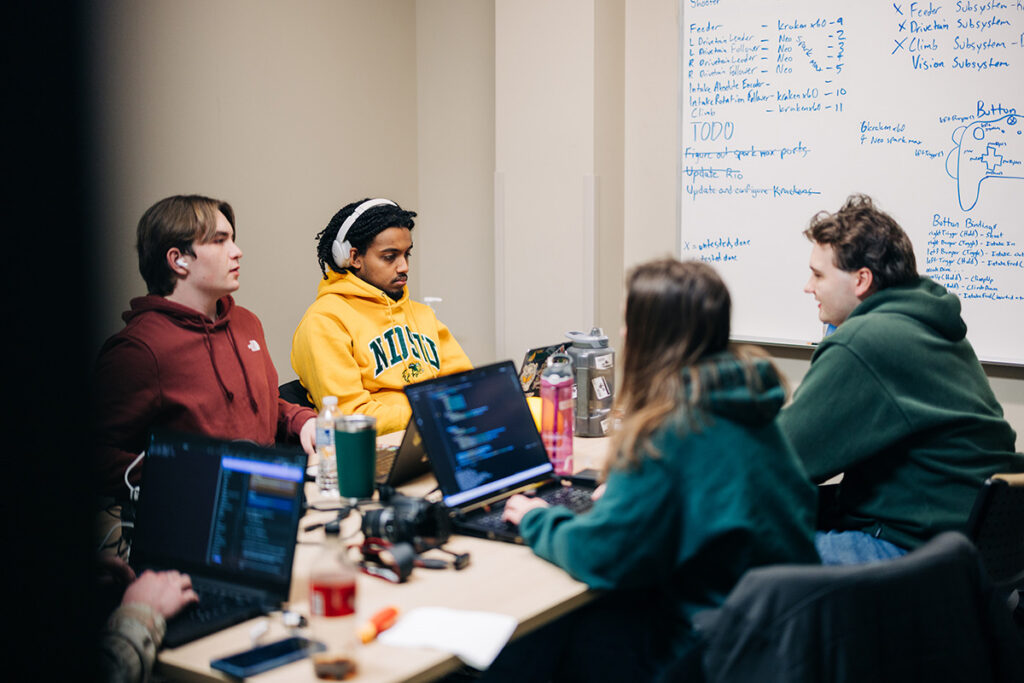
Meanwhile, in one of the small breakout rooms, the computer science and software engineers huddled around a table. With their laptops humming, code running, and the whiteboard crowded with task lists and a sketch detailing what each controller button would do, they were bringing Chad’s core systems to life.
“NDeavor has been an incredible partner for Bison Robotics,” Jacob said. “They actively look for ways to help us grow and improve as an organization.”
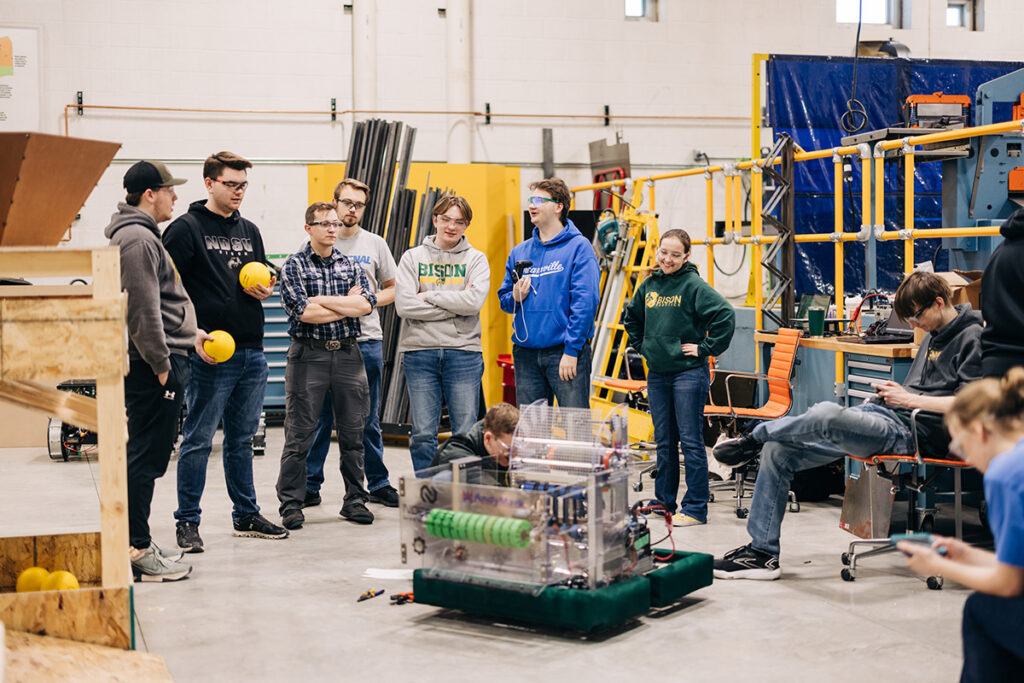
Bison Robotics team members make last-minute adjustments ahead of the highly anticipated intake, toss, and climb demo.
For Bison Robotics members, Ri3D provides early exposure to real-life engineering and the use of professional tools. But beyond technical skills, Ri3D emphasizes collaboration across disciplines under strict deadlines — conditions that mirror professional engineering environments.
“Because of the short timeline and how closely the teams work together, you start to understand the realistic restrictions and limits that each discipline faces,” Dylan said. “That carries over into future projects, where you naturally think about those constraints ahead of time. I think that makes you a better engineer.”
One of the biggest hurdles was designing and building a functional climbing mechanism. When the climb design took longer than expected, the design and mechanical teams realigned their build hours to stay on track — reflecting the kind of flexibility required in a professional workplace.
The programming team experimented with a more structured approach this year, pre-programming basic components before the build even began. Their preparation paid off, with most of the programming completed within the first day and a half, leaving time for testing and refinement and room in the schedule to adapt as the climb design was modified.
“Students aren’t just following instructions — they’re making decisions, solving unexpected problems, and owning the outcome,” Adam said. “That level of immersion and responsibility is difficult to replicate in a traditional academic setting, and events like Ri3D translate learning at NDSU into career-relevant skills.”
The students’ hard work didn’t go unnoticed. When FIRST Updates Now released its annual rankings, Chad placed sixth out of nearly 30 Ri3D teams worldwide. The recognition was a fulfilling end to an intense three-day build, reflecting the teamwork, creativity, and hands-on learning that shaped the experience.
“The high school teams we were able to help made up for the lost sleep and long build hours,” Jacob said. “Along with the robot, I hope we showed that you don’t always get something right the first time, and that’s okay. The best engineers are the ones who make mistakes, learn from them, and keep improving.”
NDSU researchers in the coatings and polymeric materials department are upholding a 120-year tradition of industry-leading breakthroughs.
Read MoreMarvin’s partnership with NDSU is a testament to the power of community, innovation, and the belief that anything is possible.
Read More Margaret and her husband, Hugh Veit ’79, established the Eleanor S. Fitzgerald Memorial Graduate Student Scholarship to support NDSU students earning advanced degrees in the Department of Health, Nutrition, and Exercise Sciences or the Department of Human Development and Family Science.

Core areas of home economics remain part of current NDSU degree programs such as accounting; apparel, retail merchandising, and design; education; family and consumer science; financial planning; human development and family science; interior design; and nutrition science.

Home economics programs opened doors, particularly for women, to earn college degrees and pursue careers in education, Extension, state and federal government, business and industry, health care, and more. NDAC listed domestic economy as one of its courses in its founding year, 1890.

Established by Dr. Teresa Conner, dean of the NDSU College of Health and Human Sciences, and co-chaired by Dr. Margaret Fitzgerald ’83 and Col. Esther Meyers ’75, the Wisdom Keepers provide support and share their knowledge and expertise with students, faculty, staff, and leadership in the College.
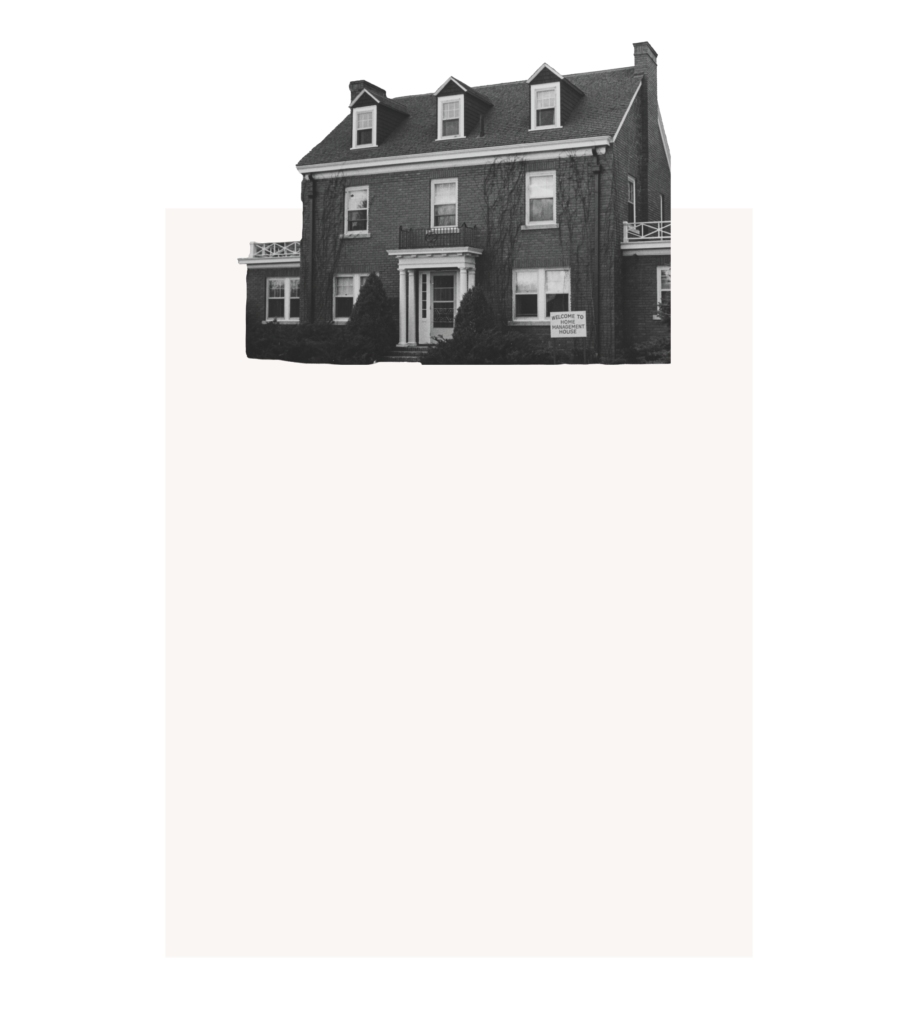
The home management house at NDAC was the first facility built on a college campus specifically for home management practice. In 1954, it was named in honor of Alba Bales, the first female academic dean at NDAC.